
Notes from a Small Island
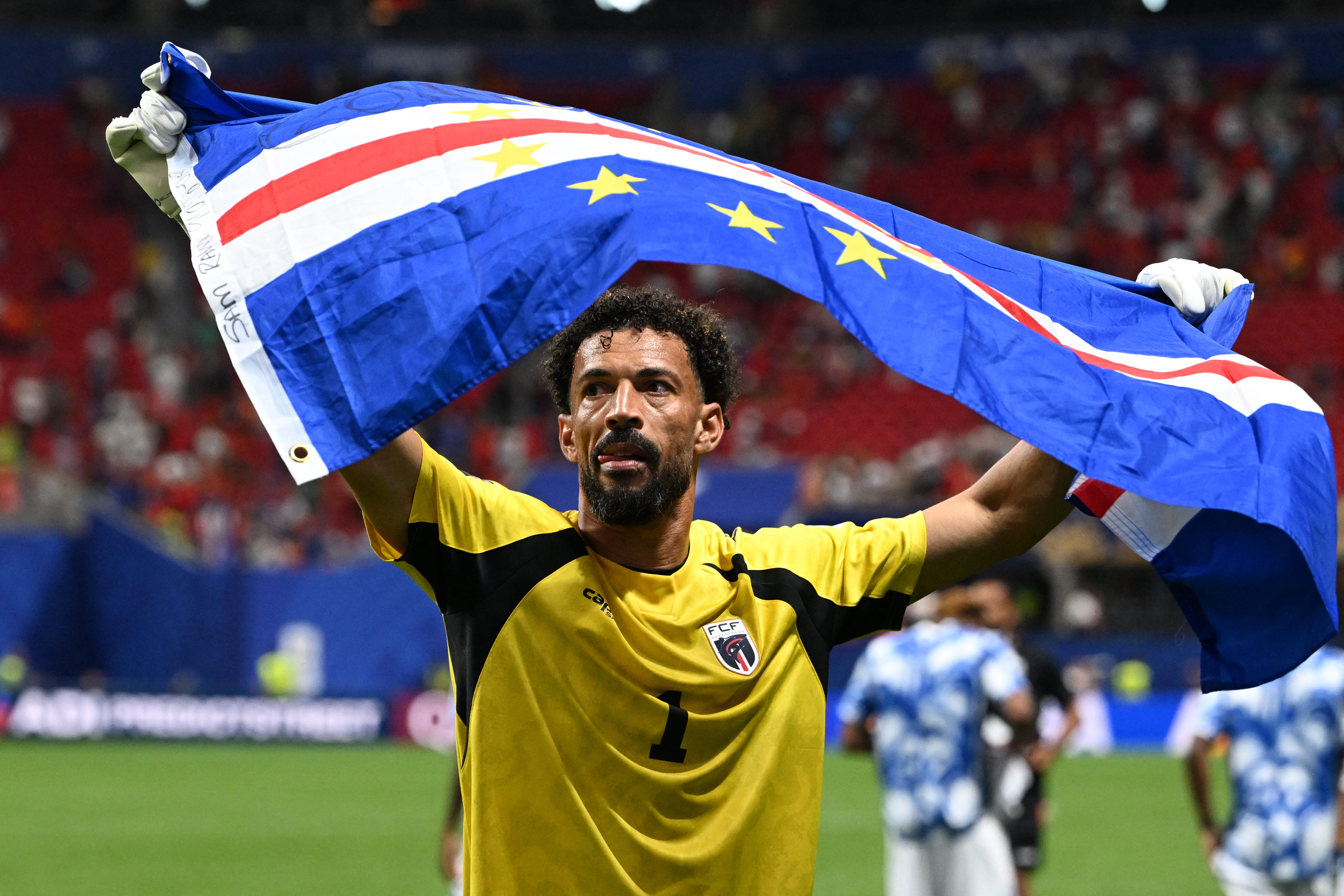
After their historic 0-0 draw with Spain last night, Simone Pierotti takes a look at the footballing history of Cape Verde.

“Cape Verde is the smile of Africa” – Cesária Évora
“We are not just a little point on the world map any longer,” said the Uruguayan politician Atilio Narancio when la Celeste won their first Olympic gold medal in the football tournament at the 1924 Games in Paris. An independent country with nearly the same population as Wales, Uruguay finally gained its place in the sun because of football. A century later, they will face in the 2026 World Cup an opponent experiencing something similar.
Nestled in the middle of the North Atlantic Ocean, Cape Verde remained in the backwaters of the history of football until October 2025, when the national team qualified for the big event for the first time while celebrating 50 years of independence from Portugal. It would be simplistic, though, to label as a miracle the qualification of a country covering an area of 4,033 km2 with 525,000 inhabitants. Indeed, Cape Verde will at least challenge Spain, Uruguay and Saudi Arabia mainly thanks to long, patient planning and to its sons of the diaspora.
Explorers in the service of the Portuguese crown found this archipelago of ten tiny, drought-stricken islands of volcanic origin between 1456 and 1460, although some legends acknowledge that the Arabs, the Phoenicians and even the Chinese adventurer Zheng He came before. According to official records, the first discoveries were made by Antonio de Noli, but other navigators like Diogo Dias, Diogo Afonso, Alvise Cadamosto and Diogo Gomes played their part. Actually, the Portuguese explorer Dinis Dias first discovered Cap-Vert, the westernmost point of the African continent encompassing the current Dakar metropolitan area: in 1444, he gave this name to the peninsula because of its lush vegetation surrounded by the desert. Once the archipelago was discovered at 240 nautical miles off the coast of West Africa, the name “Cape Verde islands” came almost naturally. Yet, during his third voyage in 1498, the famous Italian navigator Christopher Columbus underlined in his travel journal that it was “misleading”, given that “I didn’t see anything verde [green] there.”
The Cape Verde islands are divided into the Barlavento [windward] group, which comprises Santo Antão, São Vicente, uninhabited Santa Luzia, São Nicolau, Sal and Boa Vista, and the Sotavento [leeward] one, which includes Maio, Fogo, Brava and Santiago, the island
hosting the country’s capital and largest city, Praia. It was here that Ribeira Grande, the first permanent European settlement in the tropics, was founded in 1462. Located in the southern part of Santiago, Ribeira Grande stood as a pivotal port of the slave trade between Africa and Brazil. Through the years, the village was raided by the British privateer Francis Drake and visited by explorers such as Vasco da Gama and Columbus himself. Renamed Cidade Velha [Old City] when the capital was moved to Praia during the 18th century, it is now a Unesco World Heritage Site.
It was mainly its strategic geographic position, being the nearest African point to the Americas, that made Cape Verde an ideal base for supplying vessels crossing the Atlantic Ocean. The Beagle, carrying the naturalist Charles Darwin, stopped there in 1832 during a survey expedition. And it was thanks to such maritime routes that football docked in Cape Verde, particularly in São Vicente, where the main city Mindelo boasted a busy port. British workers employed in the Western Telegraph Company, who were in Cape Verde to secure wiring connection, introduced typical pastimes such as cricket, golf and tennis, and spirits like gin or whiskey. Clear traces of the British influence on local life can be tracked down in some words of the local kriolu, the native creole language based on words from Portuguese and Western Africa languages: alou (hello), arióp (hurry up), futebol, godarel (go to hell), kámon, móni, notingatol, ofesait (offside), orait, pliz, réf (referee), tenks and xuinga (chewing gum).
Clube Sportivo Mindelense, the oldest football club in Cape Verde, was then founded in 1919, although it was only made official three years later after the approval of its first charter. In those times, football was limited to São Vicente and Santiago, and the national championship was actually a colonial competition, since the archipelago was a Portuguese colony, then overseas province. Still regarded as the most successful club in Cape Verde with 19 domestic titles and a couple of national cups, Mindelense are also the only side from the islands to have taken part in the Portuguese Cup. In 1971, they challenged giants Sporting Lisbon and lost 21-0, the worst defeat ever in the history of the competition.
In those years, footballers from the colonies were considered and registered as Portuguese citizens. When the striker Jorge Humberto Raggi signed for Inter in 1961, in the Panini stickers album he appeared as “born in Cape Verde, Portugal”. Humberto did not have a great impact on Italian football, although he enjoyed one glorious night when he scored a hat-trick against Köln in an Inter-Cities Fairs Cup clash.
During the 1950s, other islands embraced the passion for the beautiful game, but the archipelago was not entirely represented when the first post-independence national championship took place in 1976. The president Aristides Pereira and the entire cabinet attended the final game, revered as a rebirth of sports in Cape Verde as well as an opportunity to reaffirm the challenges of the new, independent government with regard to sports practice in the isles. In 1974, one year before independence, a referee was assaulted after a game and fans threw stones and bottles at the car where he was hiding and at the policemen protecting him. The riot ended in a demonstration in front of the Government Palace. According to the left-wing newspaper Alerta!, the event was connected to political and social turmoil in the archipelago. Another Cape Verdean newspaper, Voz di Povo, labelled football in the colonial period as a tool of alienation and discord, and said that after independence the game should be seen as a way to make players and fans fraternise, “finally aware of being sons of the same land, and of living a completely new situation”.
Football evolved in different ways, and in different periods, in Cape Verde: while Mindelense and Sporting Clube de Praia were established in the 1920s, more than 40 years passed before the foundation of FC Ultramarina in São Nicolau (1966), Onze Unidos in Maio (1979) and Morabeza in Brava (1980). The first national cup was staged only in 1982.
Given the geography and logistics of the country as well as difficulties in moving among the islands, the national championship came after a series of regional leagues. Nowadays, there are 11 domestic leagues – Santiago and Santo Antão, the two largest islands, even have a North and South League – and the winners of each qualify for the national championship, a single round-robin tournament followed by semi-finals and final, scheduled between April and June. The Federação Cabo-Verdiana de Futebol (FCF) only supervises the final phase, with the various regional football associations running the previous rounds.
The names of several clubs reflect Cape Verde’s colonial heritage: most islands have a team called Académica, Boavista, Benfica or Sporting. In many cases, it is just a matter of affection, not of affiliation to the giants in Portugal. There are also references to international clubs such as Spartak and Botafogo from Fogo, Corinthians from São Vicente, Fiorentina from Santo Antão and Celtic from Praia.
Furthermore, the toponymy of the capital city proves that some colonial bonds have not yet loosened. In Plateau, a central high plain overlooking the port of Praia, the conflict between the desire to affirm local identity and the persistence of European occupation is evident. Here the most common meeting point is a square surrounded by the city hall, the palace of justice, the cathedral and two banks: it was named after the Portuguese colonial governor Alexandre Albuquerque. Curiously, it intersects with Rua Patrice Lumumba – named after one of the greatest Pan-African leaders during decolonisation – and Avenida Amílcar Cabral – named after the mastermind of the independence of Cape Verde and Guinea-Bissau. Yet, Praça Albuquerque is also next to Rua Serpa Pinto, dedicated to the Portuguese explorer and colonial administrator – oddly, the only two bronze busts in the area portray him and Albuquerque.
The square also connects with the southern end of Rua 5 de Julho, a distinctive pedestrian street that celebrates Cape Verde’s independence day. At the same time, right below Plateau, one of the major arterial roads of Praia runs in front of a plaza with the monument to Amílcar Cabral: that is Avenida Cidade de Lisboa, named after the capital city of the country that colonised Cape Verde. You have to drive to Cidadela and Palmarejo, in the outskirts of Praia, to find streets and roads named after the isles and municipalities of the archipelago.
Even when it comes to kick-off times the influence of Portugal is still apparent. All over the country, people prefer watching Primeira Liga rather than attending the local championship. Additionally, the publicly owned Radiotelevisão Cabo-verdiana (RTC) telecasts just one match per week of the final phase: the broadcasting of the previous rounds is left to the local clubs and their social media. If O Clássico between Benfica and Porto and a game from the Cape Verdean championship are scheduled at the same time, football acolytes will always choose the first one. As a consequence, the federation must reschedule its matches.
But it was in Portugal that Cape Verde’s football history took a different direction. “It all began at the end of the 1990s thanks to Lito,” says the football federation vice-president Inácio Carvalho aka Bala. Everybody in Cape Verde seems to have a nickname. Cape Verde is the country where you arrange an interview with the football federation vice president at a modest diner, enjoying grilled chicken or pork for just £5 – and he shows up wearing a football jersey, shorts and flip-flops.
Lito is Cláudio Zélito da Fonseca Fernandes Aguiar, a forward from the isle of Santiago who spent his entire career in Portugal, playing at nearly every level. “Not only did he decide to join the Cape Verde national football team, he also convinced other compatriots who were born abroad to follow his steps,” adds Carvalho, who was assistant coach to the national team by that time. For the Cape Verdean diaspora it was the Big Bang, opening up a way home.
The diaspora includes some major names: Patrick Vieira, Patrice Evra (a contraction of the typical surname Évora), Henrik Larsson (he took his mother’s surname, as his parents felt it would be easier for him to be accepted in Sweden), Nani, Nuno Mendes and Cristiano Ronaldo, whose great-grandmother was from São Vicente.
“At the beginning, it was the football federation who had to search and contact the potential players,” Carvalho says. “Nowadays, it is the footballers who express a desire to play for the national team, even via their agents, because they see that we are way more competitive than before.”
The Tubarões Azuis [Blue Sharks], as the Cape Verde national team is nicknamed, made their international debut only in 1978, as they lost to Guinea in a friendly. Oddly enough, the football federation was established only four years later and joined Fifa in 1986, but the national team would wait until the new millennium to participate in a World Cup campaign – they were thrashed by Algeria in the first round of the qualifiers for the big event in Japan and South Korea. Cape Verdean football finally attracted attention in 2000, when they won their first and only major tournament – the Amílcar Cabral Cup, a defunct competition for West African countries. In the final, staged at the Estádio da Várzea, a multi-purpose venue west of Plateau, they overcame Senegal 1-0 courtesy of the striker António Dinis Duarte – ‘Toni’. That team was captained by the defensive midfielder Pedro Leitão Brito ‘Bubista’, who is now the national coach.
According to the RTC journalist Elvis Neves, the rise began when Portuguese manager João de Deus served as the national team head coach from 2008 to 2010. “Under his supervision, our football profoundly reorganised itself and nowadays the federation is 100% professional,” says Neves, who also works as a youth team coach in Praia. During this spell, Cape Verde won the gold medal in the football tournament at the 2009 Jogos da Lusofonia, a multi-sport event for Portuguese-speaking national Olympic committees. In Lisbon, they overcame four different opponents, including the host country, which fielded a youth side. In the following year, Portugal and Cape Verde clashed again in a friendly ahead of the 2010 World Cup, but this time the European powerhouse brought its best players – Ricardo Carvalho, Deco, Pedro Mendes, Nani and obviously Cristiano Ronaldo. Nevertheless, the minnows held on to snatch a goalless draw.
If João de Deus was the man who sowed the seeds, Lúcio Antunes and Rui Águas were the managers who made them blossom in the following decade.
A former air-traffic controller at Sal airport, built in 1939 by the Italian government seeking a fuel and provisions stopping-point on routes from Europe to South America, Antunes attended a professional coaching course and became friends with José Mourinho. A picture showing them together hangs on the wall of a cozy tavern in Plateau right next to the house where his parents still live. Antunes was the coach of the first Cape Verde national team to qualify for the African Cup of Nations, in 2013, after eliminating Cameroon in the two-legged final round. In South Africa, they finished second in their group behind the hosts and were unfortunate to succumb to Ghana in the quarter-finals – the Black Stars advanced courtesy of a controversial penalty and a breakaway goal, with their goalkeeper Fatau Dauda making at least three superb saves. A photo with Antunes waving a big Cape Verdean flag after the qualification for the quarter-finals also appears inside the restaurant.
In the World Cup qualifiers the same year, Cape Verde seemed to have defeated Tunisia 2-0 in a crucial away game which helped them advance to the third and final round. But Fifa awarded Tunisia a 3-0 win that switched the two top standings, because Cape Verde had fielded the defender Fernando Varela. He had been given a four-match suspension after being sent off in the away game against Equatorial Guinea the previous March. Complicating matters, Cape Verde were awarded a 3-0 win because their opponents fielded an ineligible player and Varela’s red card was removed from the fifa.com website. His suspension, though, still stood.
Cape Verdean footballers who were born abroad had already been called up for the national team but the process became much more common in those years. In 2019, Águas used LinkedIn to contact the Shamrock Rovers defender Roberto ‘Pico’ Lopes, who was born in Ireland to a Cape Verdean chef from São Nicolau. As the head coach wrote the message in Portuguese, the player ignored it as he did not speak the language. Águas sent it again, this time in English, and Lopes immediately accepted the call up, although he had already represented Ireland at youth level. “When he got into the dressing room, he could speak only English,” Carvalho recalls. “Now, there is no more passionate footballer about the national team than Pico.”
Nowadays, a key figure in recruiting the sons of the diaspora is the young FCF technical director Rui Costa. “I’m the first technical director living in the country, so I’m using my experience that I gained from working as a manager in youth football in England as well to support and help,” he says. “Everyone is really prepared and this is something that has been planned, including with the Under-17 and the women’s national teams. Here it’s a bit different from England, it’s a virgin country with a lot to improve. But it’s challenging as well, because here you have natural talent.”
Rui Costa can rely upon a network of scouts who follow potentially eligible footballers playing in different leagues all over the globe. “I work alongside the president and all the staff. At the moment, we are always looking for new players to come to Cape Verde – what we want is talent and we want to win.” According to him, “we’re becoming very attractive for the way we play. We want to have possession with an intelligent way and dominate games with the ball, we have our own playing philosophy for all the youth teams and women as well - you don’t see that in Africa. And when you win, everyone wants to be with you.”
Yet, even the most optimistic football fan in Cape Verde could have hardly imagined what the Blue Sharks achieved in the last World Cup qualifiers. They were top of their group, a point above Cameroon before the head-to-head match scheduled in Praia in September 2025. Given the importance of the game, the government gave a day off to civil servants in Santiago. Cape Verde’s national stadium sits awkwardly in a barren, sunken area out of the centre of Praia. This 15,000-seat venue was funded by the government of China as a part of their stadium diplomacy policy in Africa, and cost £12 million.
On September 9, 2025, Cape Verde won what was the undisputed biggest game they had played to that point. The striker Dailon Livramento scored the winner, picking up the ball in his own half and charging through. Cape Verde fans gleefully invaded the pitch, attracted a £4,700 fine and fears they might have to play a future game behind closed doors.
In October, for the away game against Libya and the potentially decisive home match against Eswatini, Bubista called up 25 players. None of the Cape Verde internationals plays in the national championship, and they come from a range of countries – Saudi Arabia, Hungary, Bulgaria, Cyprus, the US… Beside Lopes, five players were born in Portugal, two come from France and six from the city of Rotterdam, where Cape Verdean sailors working on Dutch ships had moved in the 1960s and 1970s. “The missing step is preparing the young talents who play for Cape Verdean clubs to be at the same level,” Carvalho admits. “The domestic level is poor, the clubs are financially fragile and sponsorships are full of holes. In a country where you have many problems to solve, from electricity to education, football is not a priority. Yet we must create the conditions to encourage local players to be called up with the national team.”
Different birthplaces, different cultures, different languages. Bubista, who has been in charge since 2020, found in the kriolu the key to rule a dressing room that resembles the tower of Babel. União [union] is his mantra, as he repeated the word several times during press conferences. “First, we have to respect each other,” he says. “In our team, we have people from various countries, hence mentality and habits are different. So, we must have respect in order to understand any of them, and we must work so that they can understand each other. Starting from there, the team union means that everybody shares the same mindset, and we insist on it – there is no room for ego, nobody looks down on the others.”
While Portuguese is the official language of the country, kriolu is used in everyday life by the local as well as the Cape Verdean diaspora. It soon became the language that connects the players. “It makes us feeling our identity,” Bubista adds. “It’s the official language of our national team. Previously, we had players who could only speak English, and sometimes somebody tries to speak French or Dutch. Yet, I don’t allow it – they know that our official language was introduced so that everybody could learn it, communicate with everybody else and keep this brotherhood within the team.” The Boa-Vista-born Bubista lives on the isle of São Vicente, where he runs a popular football academy, so he has to travel by airplane to Praia for all national team training camps and games. Moreover, only two out of five coaching staff personnel live in Cape Verde, with two others settled in Portugal and one in Angola.
On October 8, Cape Verde had their first match point to secure qualification for the World Cup, when they faced Libya in Tripoli. Surprisingly, people in Praia did not show much strain while approaching the game. Fans gathered at public bars and screamed, yes, but life seemed to go on in slow motion. The match ended in a dramatic 3-3 draw, with a series of gaffes from both sides – an early own goal caused by Lopes with a volley, a blooper by the Libyan keeper as he tried to deal with a harmless shot from the midfield and, above all, a goal that would have made it 4-3 to Cape Verde wrongly disallowed for offside. The suspense was so great that even the RTC commentator Victor Hugo Fortes lost his calm. “At a certain point, we wasted a very good chance,” he recalls. “So, I started screaming ‘Why, Steven Moreira, why?’ and pounding the table with my fists. I was so nervous that I mistook Moreira for another player. Then, I realised I was commentating the match live on our national television, so I calmed myself down.”
With Cameroon wining 2-0 in Mauritius, Cape Verde were two points above their rivals for World Cup qualification. The home game against Eswatini, delayed to Monday October 13 because of presidential elections in Cameroon the day before, proved to be pivotal. Ticket sales caused tension, as people queued in huge numbers outside the vendors indicated by the football federation – the omnipresent Estádio da Várzea, three petrol stations and even a patisserie in Plateau – and the game was sold out within a few hours, with touts reselling tickets for £300 rather than 300 escudos (£3).
The following day, serenity returned to Cape Verde, as the national team had their first open training session at the national stadium. The players arrived on board an old-fashioned bus, the goalkeeper Vozinha and the defender João Paulo Fernandes answered questions in the press conference and journalists could stand on the athletics track during the training session. In the tunnel, they could even walk among the players as they stretched and nobody would reprimand them. Everybody smiled, including the national stadium supervisor Orlando Mascarenhas, better known as ‘Orlandinho’ so as not to be confused with his similarly named father, a former FCF president. Following the pitch invasion in the game against Cameroon, several Cape Verdean celebrities urged fans on social media to behave properly and 6,000 security guards were employed. “Are we expecting fans who don’t have the tickets to break through? Yes, but we’re ready to cope with it,” he said. “This is football, it happens everywhere on occasion of a big match.”
While the national team was training at the Estádio Nacional, football fans could enjoy the Gaft Cup, a pre-season tournament for both Santiago North and South Leagues, and the Stopira Cup. The latter is a youth competition named after Ianique ‘Stopira’ dos Santos Tavares, the Praia-born national team defender whose nickname recalls the former France international Yannick Stopyra. He does not bankroll the tournament, nor he is involved at any level: the Stopira Cup is just a homage to a local football hero.
The day before the game against Eswatini, Stopira and his teammates took a walk at Sucupira, a popular, vibrant open-air market. The players were applauded by pedestrians and pedlars – one woman even predicted a 2-0 victory – and approached by children for a selfie. The policemen escorted them wearing the national team jersey under their badges, and did not interfere with the collective enthusiasm. A few people passed by to secure a shirt for the following day. Once again, the atmosphere looked profoundly placid – like the waves caressing the paradisiac beaches of Santa Maria, Santa Mónica and Tarrafal.
“No stress” is the typical two-word catchphrase used on souvenirs from Cape Verde – although the local population really appears to be easy-going and nerveless, it sounds like a cliché. Perhaps, another term is more fitting to portray the Cape Verdean way of life: morabeza. It’s a creole word that refers to the spirit of warm hospitality, friendliness and the relaxed, welcoming behaviour of the people in the archipelago. It’s a feeling reflecting a generous, laid-back attitude.
Even when the day of the decisive game came, the streets were bashfully adorned with blue, red and white, the main colours of the national flag. Hawkers from Guinea-Bissau and Senegal sold little flags and jerseys, but it did not look like a great day to do business. Football fans went in dribs and drabs to the stadium, without blocking the traffic on the only road from Praia. “The average Cape Verdean is very rational,” the FCF president Mário Semedo says. “We don’t celebrate, nor do we show off too much enthusiasm until it’s over.”
Arriving at the venue four hours before the kick-off, an often-suggested move ahead of crucial football games in Africa, turned out to be overly prudent. There was no rush – even the national team bus arrived with less than an hour and a half to go. Meanwhile, the speakers spread the notes of “Sodade”, one of the most iconic songs by the Cape Verdean singer Cesária Évora, the barefoot diva.
Queuing for a hamburger at the bar of the stadium was a bald, bewhiskered man wearing an Oțelul Galați jersey with he number 8 – ‘João Paulo’. He was Alcides Fernandes, the footballer’s father. He sat at a table and started chatting with foreign journalists, recalling the sacrifices made so his son could become a professional footballer, João Paulo’s move to Portugal and his immediate return due to issues with his visa, a bad experience with an agent and the chance at Sheriff Tiraspol. Alcides admitted that he never thought that after such misfortunes he would witness such a crucial game for both his son and his native country. Nuno Ribeiro grabbed a seat for the game, too. His grandfather Gildo currently serves as the Celtic Praia vice-president after representing the club as a footballer, manager and chairman. Ribeiro particularly supported the midfielder Jair ‘Yannick’ Semedo, who plays for the Portuguese second-division club Farense. He first came to football with Celtic Praia, as he comes from Cidade Velha. “He lost his dad when he was a kid,” Ribeiro recalls. “My grandpa took him under his wing – he was like a foster father to him.”
Several authorities took a seat in the public gallery, including the ambassadors of China and Portugal and the Praia-born former Switzerland international Gelson Fernandes, who nowadays serves as a Fifa deputy chief member associations officer.
Finally, the fans arrived without being in a hurry – they packed the stadium little by little, tidily. Although it might be quite a stereotype, the stands really looked like an ocean, as people mostly wore the traditional national team blue jersey – even local journalists and policemen. In defiance of superstition, the WiFi network inside the stadium was called ‘Mundial 2026’. The players first had the conventional walkabout onto the pitch, then they came out of the tunnel for their warm-up welcomed by an ovation. The crowd erupted in a single cry when it came to “Cântico da Liberdade” [“Song of Liberty”], the national anthem. “Hope is as big as the sea,” the lyrics go, and there would not be another image to describe the feelings of an entire nation, no matter how small, totally surrounded by the ocean.
During the first half, the opponents’ goal appeared to be cursed, for Cape Verde attacked intensely only to provide inaccurate, weak or shots too near the middle of the goal because of anxiety and tension. Cape Verde had a penalty appeal turned down when the midfielder Jamiro Monteiro went down after a clash with the Eswatini goalie Khanyakwezwe Shabalala, who was repeatedly booed because of his provocations towards the crowd. Before the game, Bubista admitted that his players might battle among themselves to score the opener, and the first half ended goalless. At least, Cameroon and Angola were also drawing 0-0 in in Yaoundé.
The national stadium is one of the places in Santiago where it’s possible to avoid the moist heat, as the wind blows down from the Pico de Antónia mountain. Above all, the breeze wiped out the apprehension three minutes into the second half. Livramento tried to hit a Yannick Semedo cross with his heel and, exploiting a favourable rebound, smashed the ball into the net with a right-foot shot. He rushed to the balcony of the main stand and hugged the fans in a frenzy. While running, he celebrated the goal pointing at a fictitious watch on his wrist – he explained later he was saying, “It’s time to go to the World Cup”. The opener functioned as a starting gun, signalling the beginning of the celebrations with drums, trumpets and whistles. Five minutes later, Monteiro hit the crossbar from the edge of the box after a serpentine run by Moreira. After holding their breath in the first half, the crowd now appeared more relaxed and confident.
Cape Verde secured their spot in the next World Cup within ten minutes of the break. Inside the box, the defender Edilson Borges ‘Diney’ headed the ball to the France-born forward Willy Semedo, who slammed his shot past Shabalala. The following half-hour proved a long, draining wait for the final whistle, extended by the waltz of substitutions on both sides. The newcomer Deroy Duarte had the joy stopped in his throat, as his shot from the penalty spot skimmed the post.
But there was still time for a romantic ending. In the 86th minute, Stopira got up from his seat on the bench. Although he had announced his international retirement in June 2004, the 37-year-old centre-back was called up for the last four games to help his teammates to navigate a defensive crisis. One minute into stoppage time, he participated in a final attack and opportunistically seized on a loose ball a couple of steps from the line. From retirement to redemption, he sealed qualification for the World Cup right in front of the fans. Stopira was cautioned for taking off his jersey before being carried in triumph below the main stand.
As soon as the referee blew for full-time, the benches emptied in a joyful pitch invasion, hugging each other in tears. The team as a whole performed a lap of honour, with the fans resisting the urge to leap from the stands. A few minutes later, even journalists could walk inside the tunnel and step onto the pitch. Vitor Hugo Fortes was joyful. “Nu sta na Mundial” [“We’re going to the World Cup”] were his first words after the final whistle. “I’ve been sportscasting the national team games for more than 15 years,” he said. “I’m fulfilling my lifelong dream – doing commentary of my country qualifying for the World Cup, and travelling to do it live. I went to the Olympic Games in Paris as a journalist, but this qualification can’t be compared with anything.” Mascarenhas looked for foreign journalists to brandish his smile. “I told you that everything would be alright with the security.”
The celebrations moved to the press conference room, where Bubista arrived waving a big cardboard World Cup ticket with the inscription ‘Qualified’. He had the chance to answer to just one question, as the players barged into the room to drench him with various drinks. While smiling and laughing, he tried to compose himself. “Cape Verde is now going to be known all over the world, and that’s the first victory. Making all these people happy is extraordinary, it’s a success for all the Cape Verdeans and, above all, for those who fought for our independence.” Not coincidentally, the president José Maria Neves greeted the qualification for the World Cup as a “new independence” for Cape Verde, exactly half a century after the archipelago broke the chains of colonialism.
While the players headed for their hotel in front of the Gamboa beach, four foreign journalists and I were left to make the journey on foot, as there was no bus service running at that time. Mascarenhas agreed to help and finally found us a lift in a minivan with friends of his: a swimming-pool salesman, a night club owner, an ambassador and an MP. They offered us feijoada, a bean stew with beef or pork which is common in Portuguese-speaking countries, and grogue, the typical Cape Verdean spirit made from sugar cane – in some local bars, caipirinhas are prepared with it instead of cachaça. Then, they gave us another ride to Estádio da Várzea, home of the celebrations, where a stage had been assembled the day before regardless of fear of failure.
People danced on the grass and enjoyed gallons of beer, while Cape Verdean celebrities like the singers Djodje and Soraia Ramos entertained fans on the stage, accompanied by fireworks and music. One of Livramento’s brother, a rapper, also performed. Since the president Neves had not declared national festivities for the day after the game, it was mostly young people who lingered inside the venue. Then, the players joined the party in the VIP area. Pico Lopes did not participate, flying back to Dublin to witness his wife Leah giving birth to their baby boy Diego. They were cheered as national heroes, and to some extent they are. “I do remember our first international duties,” the 39-year-old goalkeeper Josimar ‘Vozinha’ Dias said. “There were no charter flights, and sometimes we needed too many hours to get to our destination. We also stayed at some hotels where food was not that decent.” Nowadays, the national team has its own chef and a travel agency to collaborate with to arrange overseas trips.
The day after the party, life surprisingly came back to normality as if nothing had happened, except for little flags waving on the rear-view mirrors in cars. Still, even during the party night, a big issue dominated conversations – the opportunity to travel to the US, as the American president Donald Trump does not grant visas readily to the cabo-verdianos. As a consequence, at the World Cup the national team will be mainly supported by those who have dual citizenship or by expats living in America.
The US are the country with the lion’s share of the diaspora, which has more Cape Verdeans living abroad (around 700,000) than in the archipelago, with its 500,000 population. According to an article in the New York Times, around 260,000 Cape Verdeans are estimated to live in the United States, most of them in Massachusetts and Rhode Island. The connection dates back to the early 19th century, when many Cape Verdeans embarked on whaling ships from New England, which was desperate for crews to work in such a dangerous, low-paying industry and therefore regularly sailing to Cape Verde to pick up sailors. Recognised as hard-working and solid seafarers, they inspired the character of Daggoo in Herman Melville’s novel Moby Dick.
The trickle of immigration to New England in the early 1800s turned into a flood, as Cape Verdeans fled cycles of severe drought, starvation, perennial economic hardship and colonial neglect, especially after the abolition of slavery in the Portuguese empire. They settled particularly in Boston, Brockton and New Bedford, by then a distinguished maritime centre where they became distinguished in both whaling and the fishing industry. While in the US, they used to live separately from the other African communities, probably to claim the uniqueness of their culture and identity. Furthermore, they tended to label themselves as belonging to the “Cape Verdean race” regardless of the skin colour – this ethnicity is present in the check-box for the identification in the Massachusetts census. Kriolu is among the options in the educational offer in the public schools in Boston, where the Cape Verdean Creole Institute was established in 1996 to convey the language. Unfortunately, the Blue Sharks will play their group stage games in Atlanta, Miami and Houston, where the presence of Cape Verdeans is negligible.
In the days of the World Cup qualification, one song became the unofficial anthem – “Nha Terra” [My Land] by the Portuguese-born artist Soraia Ramos. On social media, she posted a video of her singing alongside other passengers on her flight to Praia ahead of the game against Eswatini, as well as other images of the celebrations with the footballers shouting the refrain. Sung in Creole, it is a song about the Cape Verdean diaspora and the feeling of belonging and identity that does not vanish regardless of the distance from the motherland. “Cape Verdeans are scattered across the world in every direction, look where we’ve gone, look where we’ve gone,” the lyrics go. And yes, they have gone very far, even to the football World Cup.
This article originally appears in issue 61 of The Blizzard.
Image credit: ROBERTO SCHMIDT / AFP via Getty Images
Great article mate keep going who is your favourite team mate